
Let’s face it—ACLS drug algorithms can feel overwhelming at first. During a code, the last thing you want is to fumble over what drug comes next or which rhythm it treats. That’s where mnemonics come in: they’re fast, sticky, and memory-saving.
Here are some go-to mnemonic devices to help you remember the most common ACLS drugs and when to use them.
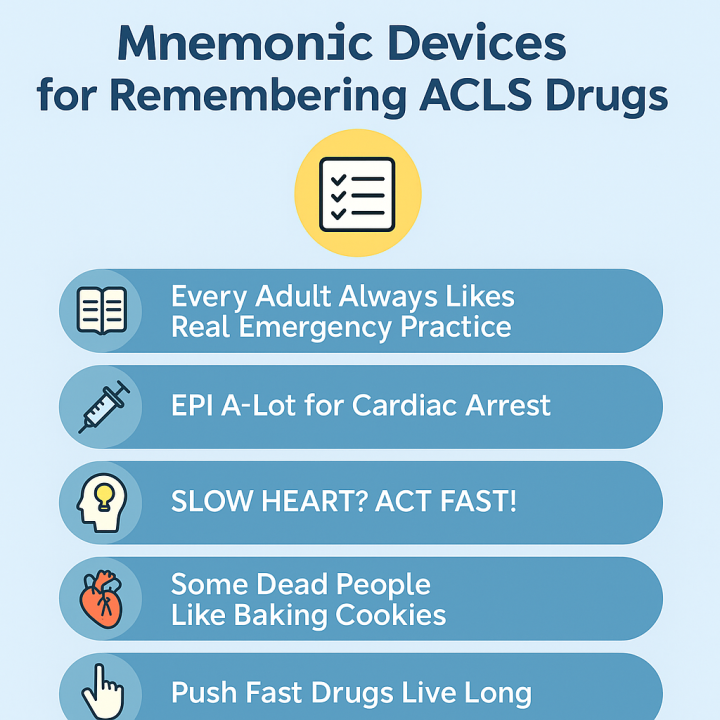
1. “Every Adult Always Likes Real Emergency Practice”
Use this to remember the core ACLS drugs used during cardiac arrest:
E – Epinephrine
A – Amiodarone
A – Atropine
L – Lidocaine
R – Rapid sodium bicarb (in special cases)
E – Epinephrine again (reinforce its frequency)
P – Push-dose pressors (like phenylephrine, dopamine, etc.)
👉 Tip: Focus on Epinephrine and Amiodarone for shockable rhythms (V-fib, pulseless V-tach) and Atropine for bradycardia.
2. “EPI A-Lot” for Cardiac Arrest
A quick way to remember the drugs used in pulseless V-fib and pulseless V-tach:
EPI – Epinephrine
A – Amiodarone
L – Lidocaine (if amiodarone isn’t available)
This short phrase helps prioritize drug administration during defibrillation cycles.
3. “SLOW HEART? ACT FAST!”
For bradycardia treatment:
A – Atropine (first-line)
C – Catecholamines (dopamine, epinephrine infusion)
T – Transcutaneous pacing (if meds fail)
Use this one when your patient’s heart rate drops and isn’t responding to basic measures.
4. “Some Dead People Like Baking Cookies”
For special ACLS medications used in unique cases:
S – Sodium bicarbonate (for hyperkalemia or TCA overdose)
D – Dextrose (for hypoglycemia)
P – Push-dose pressors (for severe hypotension)
L – Lidocaine (alternative to amiodarone)
B – Beta-blockers (for tachycardia, with caution)
C – Calcium (for hyperkalemia, hypocalcemia, or CCB overdose)
These aren’t used in every arrest but can save lives in specific scenarios.
5. “Push Fast Drugs Live Long”
Remember the order of priorities during CPR + medication:
P – Push high-quality CPR
F – Fast defibrillation
D – Drugs (as per algorithm)
L – Look for reversible causes
L – Long-term management post-ROSC
This helps you keep medications in context—they support, not replace, the core life-saving interventions.
Final Thoughts
When seconds count, recall matters. Using mnemonics not only helps you pass ACLS certification but also builds real-world confidence. The more you use these tools in practice, the faster they’ll come to you under pressure.
Train hard, think smart, and code with confidence.
